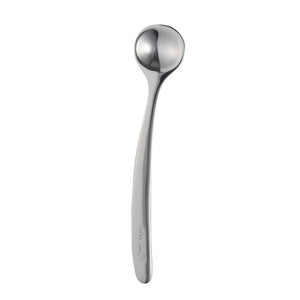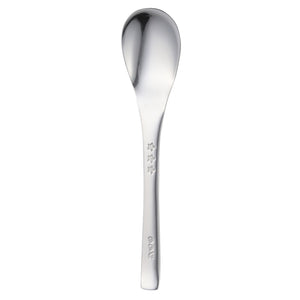


Tsubame City, located almost in the center of Niigata Prefecture, is known as the top cutlery producing area in Japan since 1911 (Meiji 44), when the first metal Western tableware was produced there.
Katariki Shoji is the company that makes Nonoji's core products, spoons and forks, in this area.
The company began polishing Western tableware in 1958 (Showa 33), and in 1980 (Showa 55) separated into the polishing division, Katariki Jiken, and the trading division, Katariki Shoji, resulting in the current structure.
Since its founding, the company has continued to polish spoons, which place importance on how they feel in the mouth, and leveraging this high level of technical skill, the company now produces a wide range of products, from household kitchen tools to outdoor goods and nursing care items, both under its own brand and as an OEM.
We spoke with Toru Katayama, the second-generation president and CEO of Katariki Shoji.
"My father, the previous owner, was better at handiwork than most people, and was known for his quick and beautiful polishing. However, the dollar shock followed by the oil shock caused many of his clients to go bankrupt. Suddenly, the business became difficult. After thinking about it, my father decided that being a subcontractor polisher was no good, so he hired a store manager to run the business. In other words, he became a general contractor."
Tsubame, a city of manufacturing, is home to a variety of subcontractors, including metal engravers and mold makers.
A consolidator is someone who brings together all the products that subcontractors have been processing in separate divisions of labor.
While Katariki Shoji handled business as a bulk buyer, it also evolved as a polisher, being one of the first to introduce automatic polishing machines.
After Katayama became the second president, the company began producing wedding gifts and novelty cutlery, creating a number of hit products.
"Our strength is that we do the final polishing process ourselves. If we want a good finish, we can do it as well as we want. That's why, even when we ship products overseas, our products have never failed inspection. There are some bulk companies that simply ship finished products, but we're different."
Katariki Shoji's pride as a polishing company can be felt when you pick up a Nonoji spoon or fork.
"The difficulty in making Nonoji products is how high we can improve the quality of the final finishing process. The quality required for novelty spoons is two or even three levels higher."
When comparing Noji spoons with those used at a certain family restaurant, the difference in gloss is clear.
The edges are carefully polished and feel great to the touch. The amount of work required to complete a single spoon makes a difference in quality.
For a regular spoon, there are roughly 11 steps: "Cutting the material" → "Penetrating" → "Rolling" → "Cutting in half" → "Handle pressing" → "Raising the pot" → "Edge rubbing" → "Barrel polishing" → "Automatic polishing" → "Cleaning" → "Inspection".
On the other hand, in the case of a Noji Spoon, it takes 16 steps: "Cutting the material" → "Punching the base" → "Rolling" → "Polishing and cleaning" → "Pressing the handle" → "Cutting in half" → "Raising the pot" → "Applying tape to the handle" → "Rubbing the edge" → "Barrel polishing" → "Electrolysis" → "Blanking the handle" → "Polishing the edge" → "Automatic polishing" → "Cleaning each spoon" → "Inspection".
The same is true for forks, as Noji products require more time and effort than the standard process.
Furthermore, because the quality of imported stainless steel varies from lot to lot, there are cases where labor is spent on pre-processing to ensure uniform quality.
Holding a shiny polished Nonoji spoon from the company's factory, President Katayama said:
"Even if it's the same spoon, if it's been polished carefully and with great care, anyone can see that it's beautiful."
Today again, the sounds of grinding echo through Katariki Shoji's factory.


1, 2 It is said that about 50,000 typical coffee spoons are polished in a polishing machine every day.
Even among the many cutlery factories in Tsubame City, Katariki Shoji stands out for the number of cutlery polished.
In the case of Nonoji products, a polishing process is added even at the base stage.


After the 3rd and 4th polishing process, each Nonoji spoon is washed and then subjected to a strict visual inspection before being shipped.