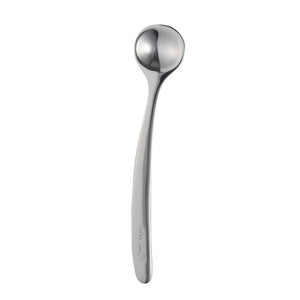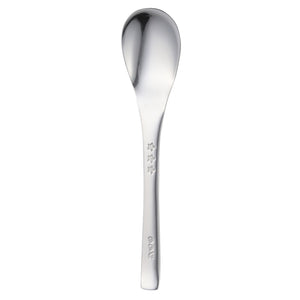


Nonoji Spoon Series
The secret to ease of use
Modern Japanese food culture is based on washoku (traditional Japanese cuisine), but it also incorporates a variety of foreign food cultures. With the Westernization that followed the Meiji Restoration, spoons and forks, like chopsticks, have become indispensable items on the Japanese dining table.
The spoon is an eating tool that originated in Western food culture, but its original purpose was to scoop up soup (food that cannot be pierced with a fork or picked up with chopsticks).
In Japan, there is a culture of drinking soup, including miso soup, by placing your mouth directly on the dish, and even today, spoons are used at the table relatively often for eating soft, semi-solid foods, or soup poured over rice, such as curry or rice bowls.
In order to scoop soup efficiently, the spoon needs to be deep enough.
However, when eating semi-solid foods such as curry with a conventional spoon, rice grains can get stuck in the deep parts of the spoon that are difficult to reach with the upper lip, or they can spill.
To avoid this, you will need to make a jerking motion.
The same thing happens if you eat fried rice with a spoon that also comes from overseas.
This movement is not particularly beautiful, and I think that being distracted by it or having to make extra movements can be somewhat stressful.
So, to help people enjoy their meals in a more relaxed manner, Nonoji spoons were designed with shapes and functions that suit Japanese food culture.
1. Make it asymmetrical.
In order to eat in a relaxed state, it is important not to unnecessarily contract the muscles in your elbows and wrists during all actions from scooping up food to bringing it to your mouth and putting it in your mouth.
For this reason, Nonoji spoons have a unique asymmetrical shape.
Japanese people scoop food from the back of their plate to the front.
The scooping area has been enlarged, and a separate area has been added to make it easier to put the food in your mouth without having to turn your wrist.
2. Set the spoon part shallow.
The shallow spoon section allows the spoon to fit comfortably along the upper lip in the mouth, allowing food placed on top to be placed in the mouth.
This means there is no need to jerk.
3. Remove all edges and make it smooth.
Texture also affects the taste.
The inside of the mouth is a delicate area protected by mucous membranes, including the tongue, a sensory organ, and teeth that are both strong enough for chewing and sensitive enough to sense the texture of food.
For this reason, all parts that come into contact with the mouth have been smoothed to remove any protrusions, allowing you to concentrate on enjoying the taste.
4.The rimmed spoon series takes this idea a step further.
A flat edge has been added around the spoon, giving the cross section a shape similar to a naturally open mouth.
This makes it possible to bring food into your mouth without having to open your mouth wide.
The edge also makes it easy to cut food off a plate, scoop up everything, and pour soup without spilling food from your mouth.
5. Make the angle of the spoon more gentle in the direction of eating.
The spoon section is shallow and at a gentle angle that follows the shape of the mouth when it is put in and taken out.
This emphasizes smoothness.
6. Making spoons for both left-handed and right-handed people Based on the concept of universal design, we offer spoons for left-handed people as tools that anyone can use without stress.
7. Made in Japan for safety.
This is done in Tsubame-Sanjo, Niigata, a production center for high-quality stainless steel cutlery products.
Nonoji spoons are available in a wide range of styles to suit different uses.
Please see the product page for the differences between each.
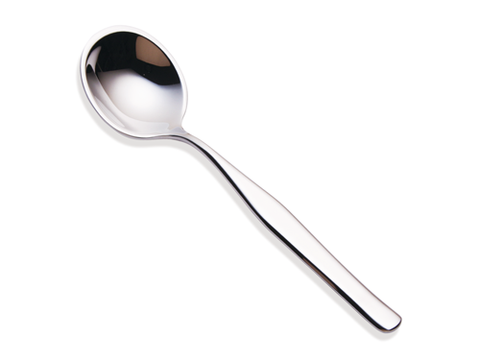
Rimmed spoon
A flat edge has been added around the spoon, and the cross section is shaped to resemble a naturally open mouth, making it possible to bring food into the mouth without having to open it wide.
The edge also makes it easy to cut food off a plate, scoop up all the leftovers, and pour soup without spilling food from your mouth.

Soft Spoon Series
All edges of the spoon have a rounded, soft finish.
It has a smooth texture and creates an unprecedented taste.
The special shape of the edge allows you to cut, scoop, and carry food to your mouth without spilling.
It goes smoothly from putting it in your mouth to placing it on your tongue.

Asymmetric spoon
This spoon is shaped in line with Japanese food culture.
There is a lineup for both left-handed and right-handed people.
The ergonomic design allows you to move effortlessly, so you can relax and focus on your taste buds!

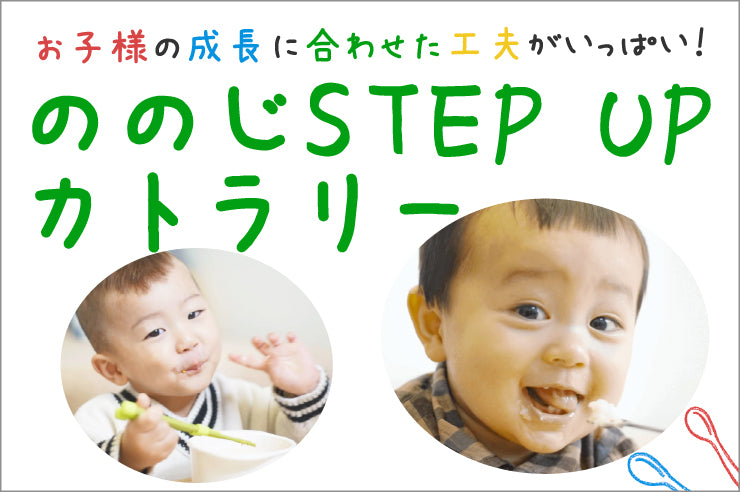
Baby & Kids Spoons
This spoon is designed for delicate babies and small children.
The size is perfect for babies' small mouths. The smoothness of the details has been carefully considered.
Your baby will eat it up! It will relieve stress for mom.

School lunch spoon
A commercial spoon used in school lunches at elementary and junior high schools.
This spoon is perfect for enjoying your daily meals.
It is designed to allow food to be transported smoothly to the mouth, making it taste even more delicious without interfering with the aroma, texture, mouthfeel, or taste.