

Uneven eating habits, spilled food... All your meal-related worries can be solved in one place♪
Tips for practicing using spoons, forks, and chopsticks for babies and toddlers
Many mothers face concerns about their children's diet.
The content varies widely, and things often don't go exactly as they are in parenting books! So, for those moms out there who are struggling, we've got advice and solutions for those troubles with feeding your kids from veteran childcare workers and Nonoji, a cutlery brand for babies and kids.
Eating also plays a major role in the development of hands and fingers.
Let's take a look at some advice based on the development of your baby's hands and fingers and their emotional growth, based on the month and age.
- Weaning period : 0-1 year olds. This is the time when finger movements are rapidly developing, so let your child experience the joy of eating.
- Weaning period : 0-1 year olds - Encourage your child to "eat on their own"
- Weaning period : When to start using chopsticks for babies aged 0-1 year and tips for practice
- Weaning period : 0-1 year olds - Meal points to check as you prepare for school age
- "First time using chopsticks properly" advice from a professional
Weaning period: 0-1 years old

This is the period when finger movements are rapidly developing.
Let's make you feel the joy of eating
Weaning age points
0 months
Birth: Once he can hold his head up, his hands become his favorite toy. He's very curious about his hands!
5 months
Starting solid food: Your baby will be able to hold things with his fingers,
In fact, the movement is controlled by the shoulders and elbows.
9 months
Late weaning stage: This is when your baby begins to be able to pinch things with his thumb and index finger.
1 year old
Complete weaning stage: Baby can scribble with crayons.
They will learn to control their hand movements and gradually begin to change the way they hold the spoon.
Weaning babies use all five senses when it comes to eating.
The sound of mom cooking, the texture, feel, aroma, touch, appearance of the ingredients, and even the feel of the spoon can all affect a child's appetite.
Just as you carefully consider the ingredients you feed to small children, you should also choose a spoon that is easy to eat from and hold.
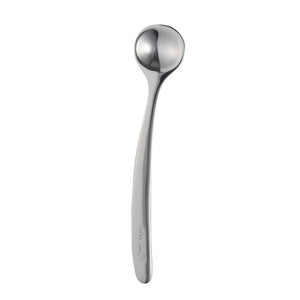
Nonoji's first cutlery, the Baby Food Spoon, has a shallow spoon with a large, smoothly polished edge, so it fits gently in a baby's mouth.
It features a long handle that makes it easy for moms to feed their babies.
The weaning period is an important time when taste buds are formed, and exposing your baby to a variety of flavors during this period can also help prevent them from becoming picky eaters.
However, it can be difficult to prepare a variety of small amounts of food, so it's a good idea to make good use of baby food.
You may be concerned about your child's messy eating with their hands, but being able to eat with their hands well is a preparation stage for using a spoon or fork.
It's important to value children's interest in food and help them feel that eating is fun!
Early childhood ① 1 to 3 years old

Encourage your child to eat by themselves
Points by age in early childhood
1.5 to 2 years old
As their molars grow in and they start eating baby food, their egos develop and they start to assert what they want, so it can be difficult for them to finish their meal.
3 years old
Children who have been cared for at home until now are now at the age where they start kindergarten. Their range of play and communication expands, and they take their first steps towards independence.
During infancy, children begin to develop independence and the desire to eat by themselves also begins to grow.
This is a time when parents should try to suppress feelings such as "It's probably not possible yet" or "There's not enough time," and watch over their children to help them understand the situation.
Using spoons and forks that are easy to use and eat from will also help children feel a sense of self-affirmation, as they will think, ``I did it myself!''
When they do it themselves, you'll want to give them lots of praise!
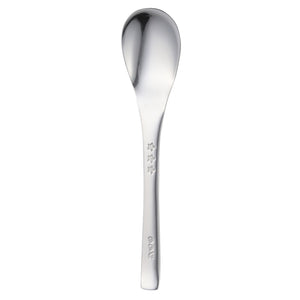
Nonoji Kids Cutlery's "Rice Spoon" and "Noodle Fork" are recommended for babies and toddlers as the edges around the spoon and the wavy fork prevent food from spilling and are flat and easy to hold.
Early childhood ② 3 to 6 years old

When to start using chopsticks and tips for practice
Checklist before starting to use chopsticks
How to approach chopsticks by age
If there are any of the checklist items that your child is still unable to do, try encouraging the development of hand movements through play.
3 to 4 years old "Younger"
By this time, children will be able to use deep scissors and glue sticks skillfully. They will also become increasingly adept at playing with chopsticks.
4 to 5 years old "All year round"
Start eating with chopsticks. Keep it fun and if it's difficult, switch to a spoon or fork.
5 to 6 years old "senior"
As your child becomes more adept at using chopsticks, be mindful of mealtimes as you prepare for elementary school life.
Early childhood stage 3: 6-7 years old

Important points to check when preparing for school age
When children enter elementary school, they will likely experience larger group living situations than they have experienced before.
Even if your child is not able to master how to hold chopsticks before starting school, they may be able to receive instruction at elementary school, so it is important for them to learn at their own pace.
Before enrolling, you may want to set goals for yourself to achieve the following:
Checklist before starting to use chopsticks
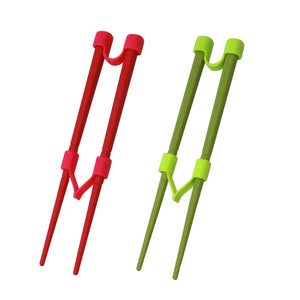
"My First Proper Chopsticks" have a marshmallow-like spring that helps them open and close, and the tips snap together just by gripping them, encouraging children to learn the correct way to hold chopsticks by learning on their own, rather than by being corrected.
"First time using chopsticks properly" advice from a professional

We spoke to teachers who have incorporated "First Time Using Chopsticks" into their childcare and elementary school classes.

Director of Yumeiku Nisshincho Nursery School (Kawasaki City). Provides unique childcare guidance that teaches nutrition education to infants from the age of 0. Actively teaches the joy and importance of eating through various experiences.
-How did you introduce the "Learn to Use Chopsticks" program?
We start with the youngest classes, but for children aged 0-2, we do thorough warm-up exercises such as "tearing" and using spoons and forks. If you start with these chopsticks when using chopsticks for the first time, it helps prevent children from developing bad habits like crossing their chopsticks. That's the main reason for introducing them. Children who use "First Proper Chopsticks" at home really improve quickly. By the time they reach the middle age, they can even skillfully use chopsticks to eat tofu in miso soup.


--What do you pay attention to when teaching people how to use chopsticks?
To learn something, it's important that it's fun. That's the basic principle. One of the many games we play is "playing with chopsticks." Through experiences and helping out, we believe it's important to get children interested in not just "eating," but also the premise behind it.
Nutrition teacher at Kodaira Municipal Kodaira 6th Elementary School. Her books include "Food and Food Education Encyclopedia" and "First Food Education Lesson."
--Please tell us about the chopstick situation among elementary school children.
More than half of children entering elementary school hold chopsticks correctly. The remaining half hold them a little differently, and there are always children who use grip chopsticks. However, adults often give up on grip chopsticks, thinking that it's fine as long as they can "eat with them." If parents don't hold chopsticks correctly, children often won't be able to hold them correctly.


--What changes have occurred since you introduced "First Time Using Chopsticks"?
At Kodaira Dairoku Elementary School, the program was introduced to second-grade classes for three months. Children who were unable to hold chopsticks properly in particular showed a change in their attitude toward chopsticks. Perhaps thanks to this, they fared far better in the "Bean Carrying Game" tournament held at school. I believe that changing people's attitudes can be a catalyst for learning to use chopsticks correctly. Some children even purchased "First Time Using Chopsticks Properly" at home and are now using them.
What is important about early childhood nutrition?
It is important to teach children that eating is fun. Children's dislikes of food come from experiences where they have eaten food in a bad atmosphere or when they have eaten food that was not tasty at all. After such an experience, it takes a lot of energy to eat that food again. If they encounter something in the wrong way, it can lead to dislike, so I want children to cherish their first encounter with chopsticks and food.
--What are some good table manners that children should learn before entering elementary school?
"Eat while sitting," "Don't play," and "Finish eating within the allotted time." But above all, I want children to be taught that "mealtimes are fun." When they enter elementary school, they begin to think for the first time about "what kind of manners are good for everyone to eat comfortably?" Picky eating habits will naturally decrease if they eat with friends.
When it comes to children's meals, not only do they need to be supervised and supported according to their age, but the choice of tableware is also important. For mothers, this may be an eye-opening new perspective, as some problems can be solved with tools.
Mealtime is not just about eating, it is also a time to interact with various people and create the future.
It would be great to have more delicious and fun experiences while also learning basic manners and etiquette together with your children, and to practice our own style of food education. May mealtimes be a favorite time for your family.